Servers, racks and network hardware are often the first things people think of when it comes to data centers. However, looking at the IT space alone is not enough to ensure stable and secure operation. In addition to the white space, the grey space also plays a central role: this is where the supporting infrastructure such as power supply, cooling, access and monitoring is located. Only the interaction of both areas creates the basis for availability, security and efficiency.
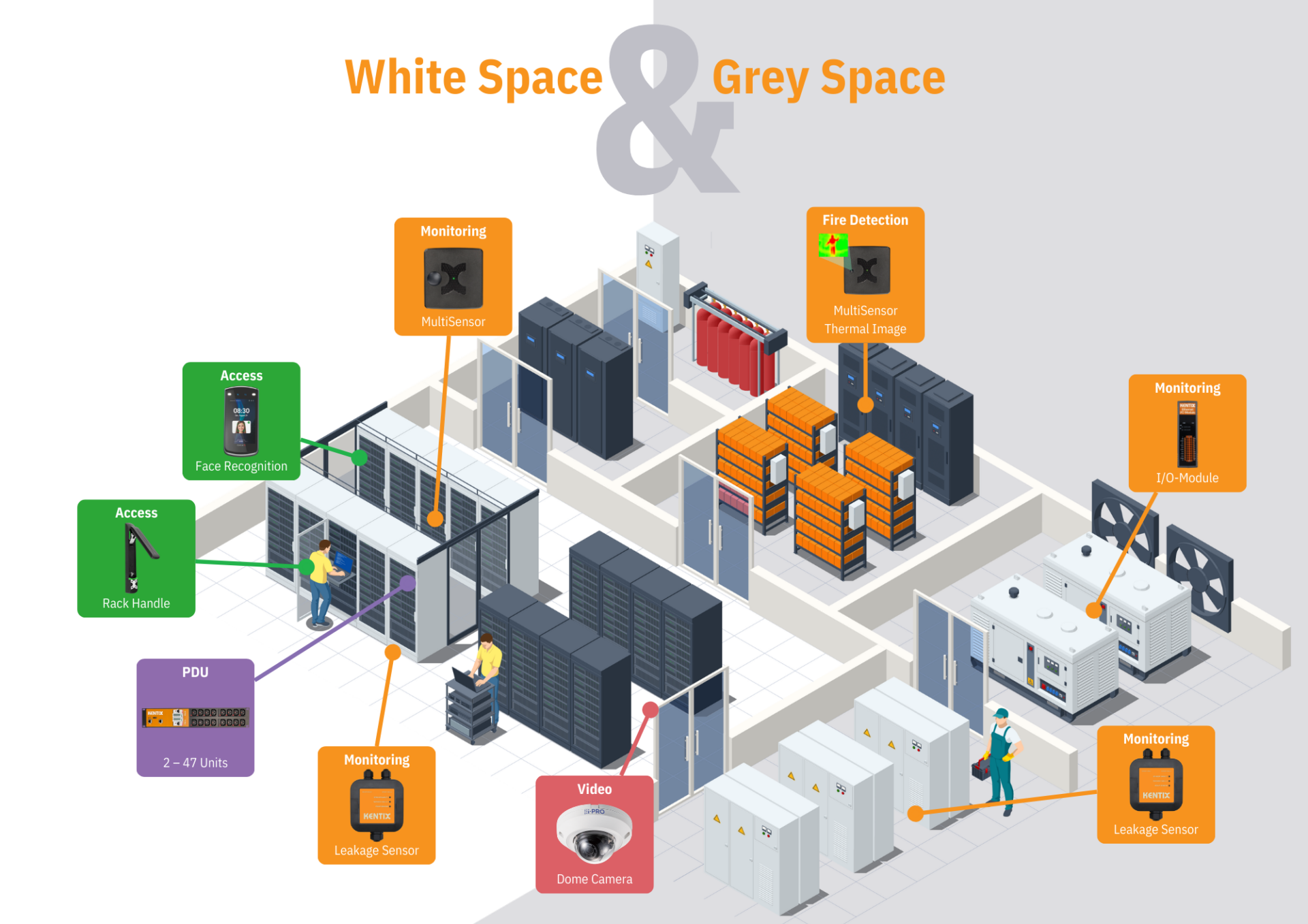
White space: this is where critical IT works
The white space comprises the areas in which the actual IT infrastructure is operated. This includes server racks, network cabinets, active components and the associated cabling. In this environment, the focus is on the protection and availability of the systems used.
Typical requirements in white space are
- Environmental monitoring in the rack and room
- Access control for racks and cage areas
- Temperature and humidity monitoring
- Leakage detection
- Power distribution and power monitoring
- Video surveillance of sensitive IT areas
In white space in particular, even small deviations can have a major impact. Temperature rises, unauthorized access or moisture often go unnoticed for a long time if there is no continuous monitoring.
Grey Space: The technical infrastructure in the background
The grey space forms the technical backbone of the data center. Among other things, it houses the power supply, air conditioning and cooling systems, security and access solutions as well as other infrastructures that make the operation of the white space possible in the first place.
Typical applications in the Grey Space include
- Monitoring of energy and supply systems
- Monitoring of air conditioning and HVAC systems
- Early fire detection
- Leakage detection on technical systems
- Access control
- External alarm forwarding and video surveillance
If a component in this area fails or a critical change remains undetected, this has a direct impact on IT availability. Grey space should therefore not only be considered, but also specifically safeguarded.
Why white space and grey space need to be considered together
In practice, white space and grey space are often considered separately. However, a holistic view is crucial for resilient operations. This is because risks arise not only where IT is operated, but also in the technical environments that supply and secure this IT.
A consistent safety and monitoring concept therefore combines both areas:
- Protection of IT components in the white space
- Monitoring the supporting infrastructure in the Grey Space
- Early detection of critical changes
- Central alerting and transparent status overview
This is exactly where Kentix comes in. With an integrated approach for monitoring, access control, early fire detection, leakage detection and alarming that covers both areas. This means that white space and grey space cannot be viewed in isolation, but as a coherent security and operating environment.
Conclusion
White space and grey space perform different tasks, but are inextricably linked in the data center. While critical IT is operated in the white space, the grey space ensures that this infrastructure can work securely, stably and continuously.